
BuildingEnergy Access Spotlight Interview: ChopValue

COMPANY SPOTLIGHT: ChopValue Boston
BuildingEnergy Access is a NESEA initiative to support the work of WMBEs (women and minority-owned business enterprises) by connecting them with the resources of the NESEA community. Each month, we'll introduce a participating company to the wider NESEA community through a spotlight interview.
We recently sat down with Elaine Chow of ChopValue Boston, minority-owned and operated business creating premium wood alternative products from discarded chop sticks at their local Microfactory in Charlestown, MA. We sat down to discuss the business, circularity, and their participation in the BuildingEnergy Access program.
Ian Reed: So, first off, can you share a 30-second version of your company description?
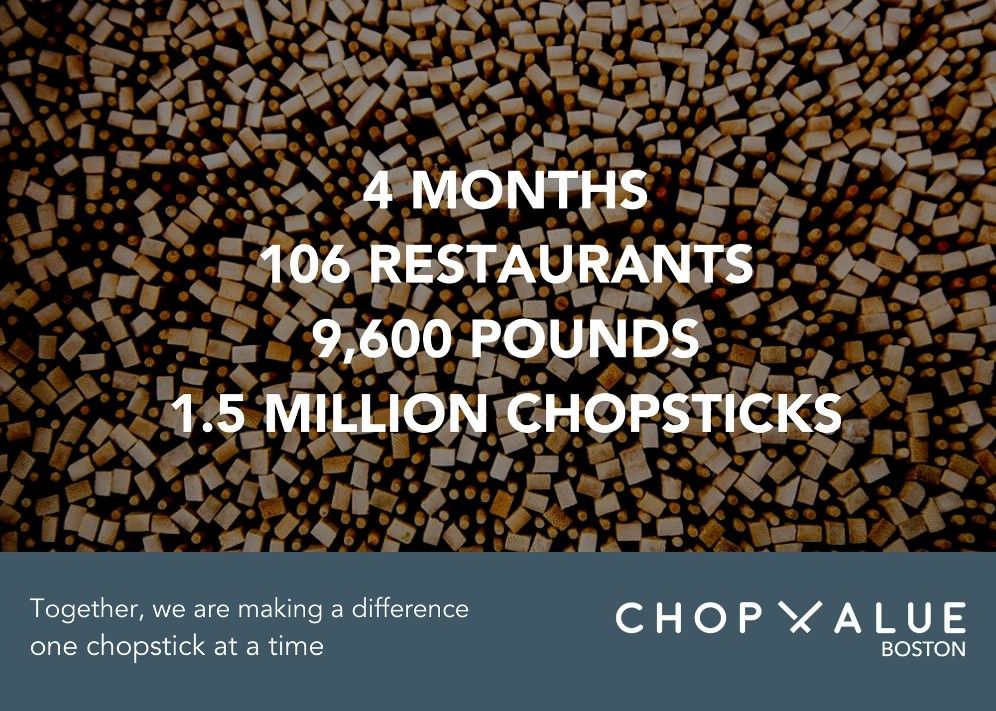
Elaine Chow: ChopValue Boston recycles used chopsticks from local restaurants and brings them to our microfactory in Charlestown, where we transform them into a new composite material made only of chopsticks and a water-based resin. This material that becomes the building block for everything that we make: home/corporate gifts (e.g. swag), office furniture - tabletops/countertops, and architectural interiors like wall paneling and signage.
IR: Obviously this isn't the most typical business jump into and get off the ground. What attracted you to this sort of business structure?
 EC: This is a big career change for me. After I spent 20 years in nonprofit management, I was wanting to do something different. I knew that the next step for me would involve sustainability; I was feeling a lot of urgency there, and I wanted that to be a big part of my next efforts.
Beyond that, I was just kind of open to figuring out what it was that I wanted to do next. I didn't really set out to start a small business. I saw a Business Insider video about ChopValue, and I was just fascinated. I had become interested in woodworking as a hobby during the pandemic. I am very passionate about recycling. And also, I am Asian. I grew up using chopsticks every day. My parents were immigrants to this country and they owned Asian restaurants. I spent time after school in Asian restaurants growing up. And so [ChopValue] was just a very interesting kind of meld of all of my different experiences together. I realized that the circular economy has so much potential, and there are so few examples of it really working and being viable. I wanted to kind of help jump into the fray and see if I could help make ChopValue an example of a circular economy that is working for the Boston community or for Massachusetts. It just seems like that if it could work anywhere, it could work here. So, I've been chipping away at that, testing that hypothesis, for the last three years. (ChopValue is a franchise; We're an independently owned franchise in Massachusetts, but the idea started in Vancouver.)
IR: Well, congrats. Three years is great. You came into this business with a ton of experience managing organizations, people, and so on in the non-profit world. What have you learned from starting this new experience versus the information carried in?
EC: I finished business school in 2007, so it's been a minute. And most of what I was focused on in business school was really how to use those skill sets for the social impact (nonprofit) space. I was really focused on helping to optimize really great organizations in the operations, or people and culture processes space. I never dreamed that 20 years later, nearly, I would be revisiting the things that I learned in business school and putting them into a manufacturing or small business context. So, there's been a lot of learning around that.
I heard all the time that starting a small business is really hard, and now I can a hundred percent say, “yeah, I totally get that.” But it's hard in a way that, I didn’t fully appreciate before starting my own business. There are all these things that you have to worry about, stuff you take for granted when you're working for someone else. Like no built in IT systems, and how expensive Adobe Reader is!
IR: Preaching to the choir about Adobe. I can't stand that company.
EC: It's just really hard because you're very much on your own. Which isn’t to say I haven’t had help; there has been immense support from a lot of different areas, and NESEA is one of them. But, yeah, it's been a huge learning curve.
We're finishing our third year of production. I am a better woodworker. I've learned how to be a business owner. I am learning how to be a salesperson, even though I hate that. <laugh>
IR: it’s a lot to ask of one person. And a lot of learning!
EC: Having been in nonprofits for so long, I had a very different professional network than the one I am now building. I am building new connections in the trades, in architecture and design, in manufacturing spaces, even the public governance spaces, connecting with people that are promoting supplier diversity in small businesses. All the people that are working on our behalf in terms of the city and the state levels has been just amazing.
IR: That's awesome. Your business produces such a wide variety of products, I'm imagining that it requires a pretty diverse skillset in your employees. Has hiring been a challenge? Finding the right people for the right roles?
EC: We don't have that many roles to fill. Right now, I've got three and a half people, and most of the roles are entry level and trainable within a day, within a week. It’s mostly entry level woodworking and on the manufacturing side, it's all about repetition, and being able to keep up with repetitive machine work. You need somebody with attention to detail that knows what they're looking for at each of those stations. But it's highly trainable.
The one position that I've struggled to get right, is basically my right-hand person. Ideally, I'm really focused on building the brand, being out there in the community, selling, talking about the circular economy, and not spending a lot of time on the production floor. I think, as you can see, I am on the production floor today <laugh>
The Production Lead manages the entire manufacturing operation, and that has been a really tricky role to fill. There is a lot of talent out there, but honestly perhaps not in my budget range, which makes it hard.
IR: Interesting. I'm curious if there's a project or initiative that you're working on right now that you'd like to bring some attention to that you're particularly proud of?
EC: We’re in process with a large bank to make all the LEED and Net Zero certification plaques for their branches nationwide - potentially worldwide, which is exciting! We’ve made a few prototypes and are narrowing in on a final design.
.png)
IR: Oh, wow. That’s great.
EC: USGBC is also following the project closely and might want to consider offering it as an option to anyone who needs a LEED plaque.
Just from a mission standpoint, if we were able to be the maker of all the LEED plaques that go out into the world, I think that would be so meaningful. Yes, it would be a steady source of revenue between all these larger commercial building projects that take forever to close, but it’s also a project that speaks to our mission and worldview. In this case, our work adds value to other people’s decarbonization efforts.
Aside from that, I think the project that was most special to me was designing and installing a feature wall in the lobby of a new affordable housing building in Chinatown. It's a hundred percent affordable housing units and it was one of the last open undeveloped plots of land in Chinatown. It was the parking lot, previously. The Chinatown neighborhood associations worked together with the City of Boston to develop 80 units of affordable housing, which if you know the Boston housing market, is desperately needed. They had an inordinate amount of applications for those units.
IR: That's huge. Yes, much needed.
EC: And what's so cool about that is that we get so many of our chopsticks from Chinatown. We were able to take that discarded “waste”, and make it.png) into something really beautiful; a piece of art for that building. It's now there, and on display, and it's kind of our gift back into the community in this affordable housing building. There were just so many kinds of “full circle” moments on that project. That felt really fulfilling.
into something really beautiful; a piece of art for that building. It's now there, and on display, and it's kind of our gift back into the community in this affordable housing building. There were just so many kinds of “full circle” moments on that project. That felt really fulfilling.
IR: As you were telling that story, I kept thinking of the word “circularity”; there’s clearly several levels to that concept, both in material terms, but also in human terms.
EC: There’s a lot of it going on. Yeah. To me, it's really special.
I would love to continue contributing to Chinatown. I'm hopeful about things like the Chinatown Library, which has been in development for years and years and years, and who knows if it'll ever happen, but it seems like a no-brainer for all the tables in that library to be made from chopsticks that were recycled from Chinatown.
IR: Definitely.
EC: I think there's a lot of meaning in this for people. We don't have to be using virgin materials and shipping them in from abroad. We can make these things locally. We deliver everything as locally as we can. No crates, no packaging. We just blanket wrap them and drive it over.
IR: That's awesome. Well, that actually kind of leads perfectly into our next question; Where do you plan on taking the business in the future. It seems like you're kind of open to possibilities right now.
EC: Yeah, we're really struggling. I think a lot of people right now are really struggling.
IR: Yes, I agree.
EC: 2022 was not the best time to start a business <laugh>. And certainly not the best time to start one that is so reliant on commercial building and the building trades. Obviously, everyone in this space is experiencing this slowdown. I would say any project big or small is welcome. I think, right now, the smaller projects actually convert more quickly and that is more helpful. But we're open to pretty much any type of work. We haven't done a ton of residential work yet, but we're working on a dining table right now for somebody in Arlington. I could see that expanding.
For larger buildings, I think we could make something really cool in the amenity space, like a package pickup counter or something like that. Essentially, anything that folks are open to trying with us, we would love to have a conversation. Up until now I think our bread and butter has been B2B in commercial spaces, but we’re also doing creative things with awards and medals. The Vancouver team just made all the medals for the Vancouver Marathon. The versatility of what we make, and our product, means we can work on a lot of different types of projects, which keeps things exciting.
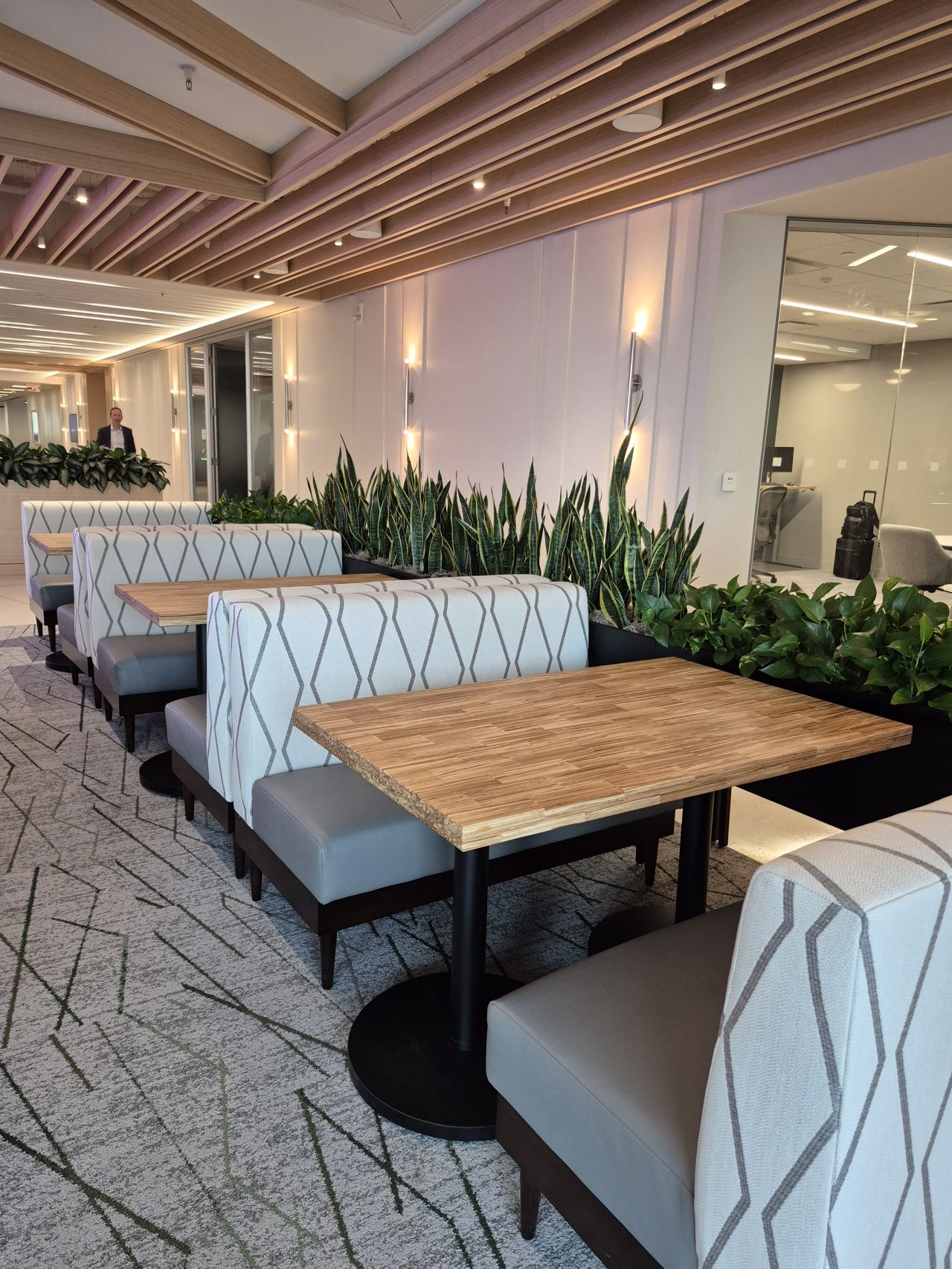
I think there's like really interesting applications for what we can do with this stuff. It's a challenge to succinctly tell the story of what we're doing because our product mix is so broad, but the plus side of that is there are endless possibilities for application. From furniture, to interior wall paneling, signage. I think there could be a lot of potential with signage actually. We also do a lot of work around holiday gifting and corporate gifting. If folks are giving out branded items to their clients, they should consider us because we can do something much more meaningful and unique, I think, than a lot of the ‘swag companies’. Who needs another water bottle?
IR: Yeah. <laugh>, not me. <Laugh>. Shifting a little bit to your participation in BuildingEnergy Access - Could you talk a little bit about how that experience has been for you?
EC: I would say, first and foremost, “supportive”; in terms of peer community and finding support, it’s been great. It's been a way for me to get to know the building and trades space in a safe sort of space. I had actually come across several members of the cohort networking prior to joining.
And they were the people that I called for help when the first time I got a real subcontract.
I called JC , who is now in my cohort, because she's been in construction forever. And I was able to say, “what does this 60-page contract mean? And am I making a mistake by just signing it and not pushing back on anything?" She literally just walked me through the whole thing, and gave me advice on where to propose changes. She made a whole safety plan for our installation day, like for me. That's what I mean by saying, “there's no question that's too dumb” or “no one’s going look down on you for never having had a subcontract before.” It's just been really great and supportive from that perspective.
IR: Oh, I love to hear that. That's really nice and exactly what the program is designed to do. Are there any other aspects of NESEA’s programming that you're interested in checking out?
EC: I think the cohort was confirmed right before the conference?
IR: Yes, the 2025 Boston BuildingEnergy Conference
EC: Yeah, right before the BuildingEnergy Conference. I went to the [BuildingEnergy Access] breakfast, which was honestly my first contact with NESEA and that community. I would definitely like to meet more people that are specifically focused on circularity, I could learn more about that for sure. I would love to meet people who are interested in promoting that. I’m interested in expanding my network in the building space. And obviously people who would be interested in trying our products in their projects is totally, extremely interesting to me.<laugh>
IR: Totally. That makes sense. Well, that about covers it, thank you. It was a pleasure to talk to you. Cool business! <laugh>.
EC: <laugh> Thank you. Bye-Bye.